Comparisons
Unbounce alternatives: build more landing pages, or make the pages you have convert
By Alparslan Kapani · · 10 min read
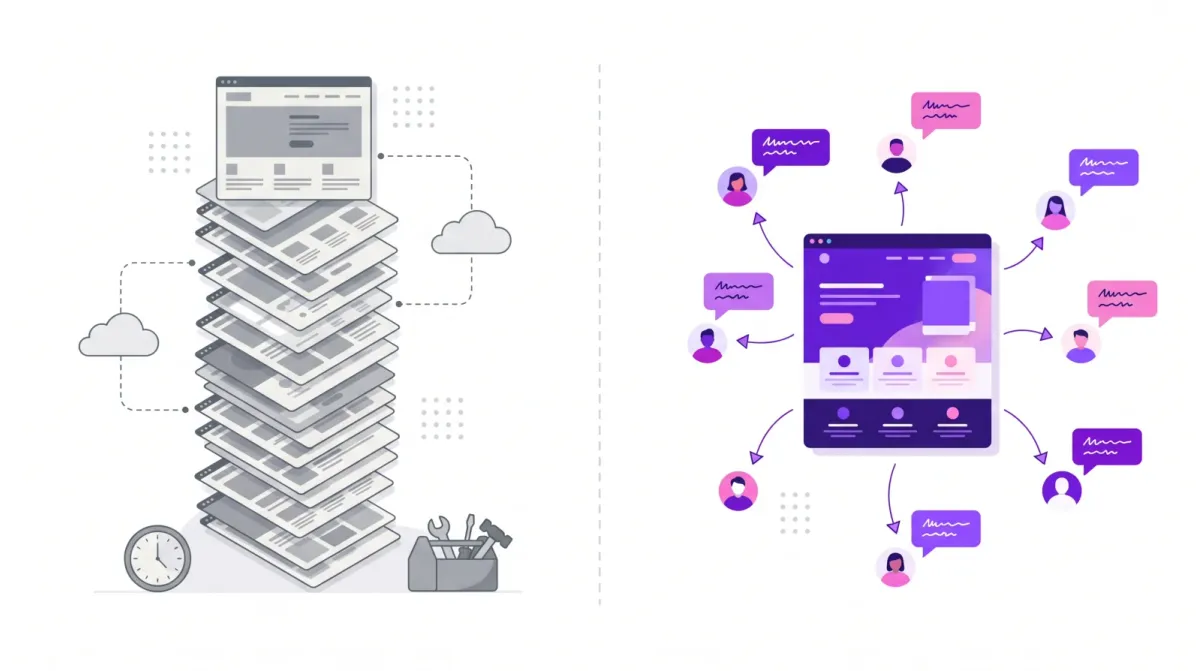
There are two kinds of Unbounce alternatives. Other landing page builders do the same job with different templates, limits and prices. The other route is to stop building pages: personalize the pages you already have, so every visitor type reads a version written for them on the same URL. If you use Unbounce to build a new page for each campaign or audience, the second route usually saves more time, keeps your SEO history and converts more of the traffic you already pay for.
I’m Alparslan, the founder of Convertus.ai, which takes the second route. So yes, I’m biased. I’ve kept this comparison to facts from Unbounce’s own pages, checked in November 2026, and I’ll tell you where Unbounce is the better choice.
Key takeaways
- Unbounce is a builder: you design new pages, host them on a subdomain such as
try.yoursite.comand route visitors between the variants you build. - Convertus.ai adapts your existing page instead. The AI writes the version for each visitor segment in seconds; you approve or edit it. No page to build, host or maintain.
- Targeting goes much deeper than a keyword in the URL: what a visitor did on your site, the value they picked in a dropdown or typed in a form, what they did and didn’t do.
- Convertus.ai doesn’t do A/B testing, on purpose. Scaling personalization converts more visitors than testing two versions of one page.
- If you run Google Ads, Convertus builds the campaign too, and every ad group lands on its own version of your page.
What are the main Unbounce alternatives?
Most “Unbounce alternatives” lists compare builders: Instapage, Leadpages, Landingi and others. They differ in templates, page limits, integrations and price, but the job is the same as Unbounce’s: you build a separate page for every campaign or audience you want to address.
The other alternative is a different approach. Instead of building page number 4, 5 and 40, you keep your website and change what each page says to each visitor. That’s website personalization, and it’s what Convertus.ai, an AI tool for website content personalization and Google Ads automation, does. It solves the reason most people start building landing pages in the first place: the main site says the same thing to everyone.
When is Unbounce the right choice?
Unbounce is a mature, well-liked builder, and for some jobs it’s the right tool:
- You need a brand-new page that doesn’t exist yet, and you have no CMS like WordPress to build it in: an event, a product launch, an offer with no home on your site. If you do have a CMS, build the page there, then let Convertus write a version of it for each visitor type in seconds.
- You want classic A/B testing: Unbounce includes unlimited A/B tests from its Experiment plan.
- You like designing in a drag-and-drop editor and have the time to build and maintain pages.
If that’s your situation, a builder makes sense. If you’re building pages mainly so that different visitors see a message that fits them, read on.
Unbounce vs Convertus.ai at a glance
| Unbounce | Convertus.ai | |
|---|---|---|
| What it is | Landing page builder with A/B testing and AI traffic routing | AI personalization of your existing pages, plus Google Ads automation |
| Where pages live | On Unbounce’s hosting, on a domain or subdomain you connect by CNAME (or via its WordPress plugin) | Your own pages, same URLs. One snippet or Google Tag Manager; one click on WordPress |
| Content per visitor | Dynamic Text Replacement swaps text from a URL parameter; AI traffic routing sends each visitor to the best of the variants you build | The AI writes a whole-page version per segment in seconds; you approve or edit |
| Targeting | URL keyword (DTR); device, location, browser and more (AI traffic routing) | UTM source, campaign, ad group and keyword (utm_term); on-site events you already send; dropdown and form values (equals, contains, above or below); did X but not Y; returning visitors for 90 days |
| A/B testing | Yes, unlimited from the Experiment plan | No, on purpose |
| Google Ads | Landing pages for your ads | Builds Search campaigns from one prompt, optimizes them weekly, matches each ad group to its page version; competitor intelligence included |
| Starting price | $29/month (5 pages, 500 visitors); DTR and A/B testing from $149/month | $99/month (10,000 personalized page views); Bundle with Google Ads from $135/month |
| Free trial | 14 days, no credit card | 14 days, no credit card |
Unbounce facts from its pricing page and domain documentation, checked November 2026.
Why build a new page when the one you have already works?
The page you already have carries a lot that a new page has to earn again: an approved design, your brand and legal wording, tracking that works, integrations, and its SEO history: the rankings and links it has collected over the years.
A builder page starts from zero on all of that. Unbounce’s own documentation recommends publishing on a subdomain such as try.mysite.com, because your main domain is already your website. So every campaign page is a new URL to design, connect, track and keep up to date when your offer or prices change.
Convertus works the other way round. You add one snippet (or one click with the WordPress plugin), pick a page and a segment, and the AI reads the page and writes the version for that segment in seconds. You see the original and the personalized text side by side, approve it or edit it, and switch any part on or off:
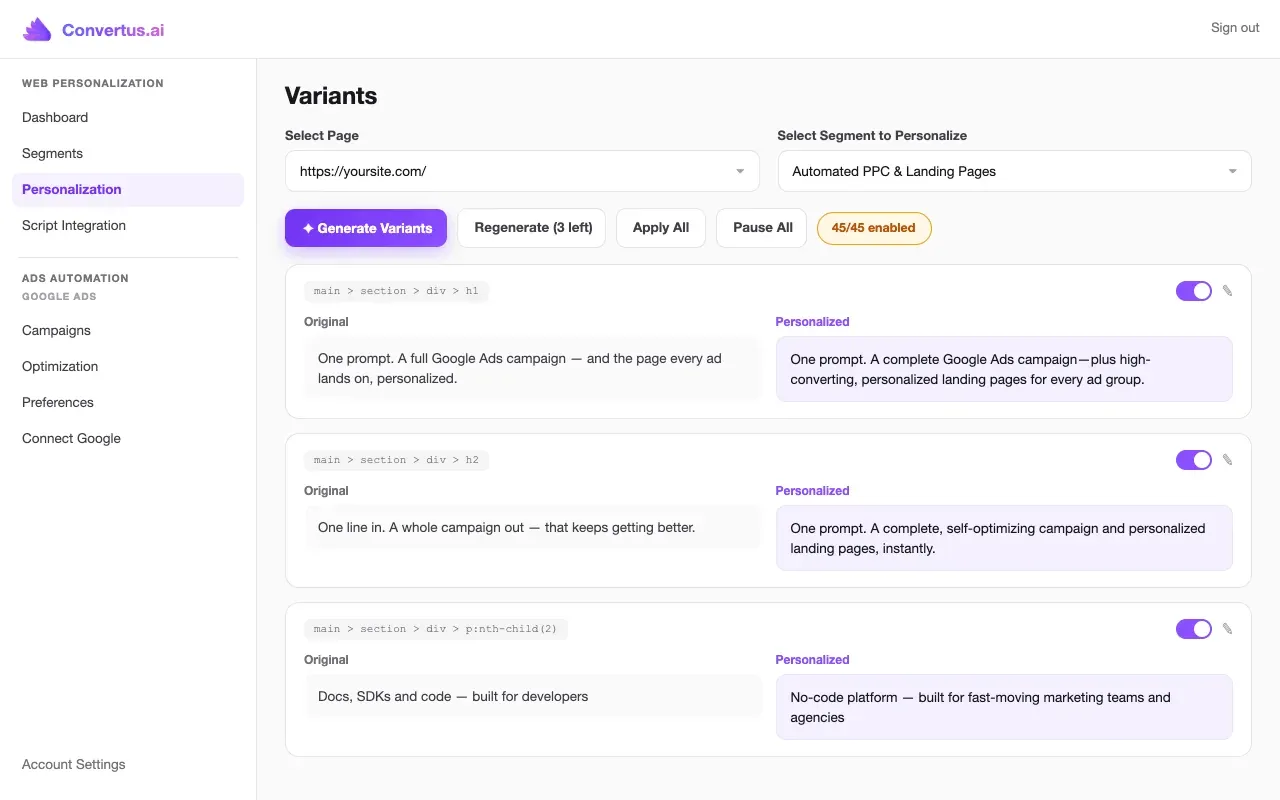
What that changes for your business: no designer and developer hours per campaign, no page to keep in sync with your main site, and no new URL that has to build its own history. A new audience becomes a few minutes of review instead of a project.
How deep can you target a visitor?
This is where the two tools differ most.
Unbounce gives you two ways to match a visitor. Dynamic Text Replacement takes a word from the URL (usually the keyword from a Google Ads click) and drops it into the page. AI traffic routing sends each visitor to whichever of your variants should convert best, based on things like device, location and browser. Both need the pages and variants to exist first: you build them.
Convertus targets on what the visitor actually did and told you, and changes the whole page, not one word:
- Where they came from: any UTM source, campaign or ad group, down to the keyword (utm_term): the newsletter, a partner link, your own social posts, a specific ad, the exact search behind a click.
- What they did on your site, read from the Google Tag Manager and Google Analytics events you already send. No new tracking, no code.
- What they typed or picked: a dropdown choice, a form value, a number above or below a threshold, a search term that contains a word.
- What they did, and didn’t do: read the pricing page but never requested a quote; started the form but didn’t send it.
- Returning visitors for 90 days, so the second visit can pick up where the first one stopped.
You can segment down to a single person if you need to, by one dropdown choice. A few sources, a few actions and a few visitor types quickly add up to 300+ visitor situations, while most teams build three landing pages. No team can build a page per situation. The AI can write a version per situation.
In the comparison tests I’ve run, the personalized page has ended with the higher conversion rate every time. That’s not a surprise: a visitor who reads exactly what they came for has less reason to leave.
Do you need A/B testing?
Convertus doesn’t offer A/B testing, and that’s a deliberate choice, not a missing feature.
An A/B test splits your traffic between two versions of one page and waits until one wins. To get a reliable result you need a lot of traffic, often weeks of it, and the prize is usually a small lift for one page that every visitor then sees. Most small and mid-size sites never get enough traffic to finish more than a few tests a year.
Personalization scales in the other direction. Instead of finding the one best page for everyone, each visitor group gets the page that fits it from its first visit. Adding the next segment is minutes of review, not another month of waiting for a test result, and every segment you add converts more of the visitors you already have.
What about Google Ads?
A lot of Unbounce pages exist for one reason: paid traffic. If that’s you, the page is only half of the job.
Convertus.ai builds the Google Ads side as well. You describe the goal in one sentence, and the AI reads your site and drafts a complete Search campaign: multiple ad groups, each matched to the best-fitting Google audiences, keywords chosen by real search volume, and ad copy written from that research. Competitor intelligence is included: it finds the searches your rivals win and can feed them straight into a campaign. It also shows which of those searches are winnable, with real demand at low or medium competition, so you know which pages to write or strengthen and can grow your organic traffic too. You review the draft and publish it to your own Google Ads account in one step.
After that, it optimizes the campaign every week: it adds keywords and negatives, pauses spend that doesn’t convert, and adjusts match types, audiences, bids and budgets. Budget and bid changes always wait for your approval.
And each ad group lands on its own version of your page, on the same URL. That matters to Google too: landing page experience is part of Quality Score, and a page that says what the search said earns a better score, which lowers what you pay per click for the same position. If you’re on WordPress, here are three ways to give every ad group its own headline.
Unbounce pricing vs Convertus pricing
Unbounce prices by plan, pages and monthly visitors (pricing page, November 2026):
| Unbounce plan | Monthly | Pages | Visitors | What it adds |
|---|---|---|---|---|
| Starter | $29 | 5 | up to 500 | AI copywriting |
| Build | $99 | unlimited | up to 20,000 | |
| Experiment | $149 | unlimited | up to 30,000 | A/B testing, Dynamic Text Replacement |
| Optimize | $249 | unlimited | up to 50,000 | AI traffic routing |
Convertus prices by personalized page views for personalization and by ad spend for Google Ads, so the meters aren’t the same. Personalization starts at $99 a month for 10,000 personalized page views, Google Ads automation at $99, and the Bundle of both, with competitor intelligence, at $135 a month. The full ladder is on the pricing page.
The fairer comparison is what you’d otherwise build. Matching visitors in Unbounce starts at $149 a month, before the design and build time for every variant. In Convertus that’s the core of the product from the first plan.
What do Unbounce users complain about?
Unbounce has a solid rating on G2 (4.3 out of 5 from about 386 reviews), and users consistently praise how easy the builder is. The complaints that come up again and again in public reviews are:
- Price: rises over the years and costs that grow with traffic tiers and connected domains, especially for small businesses.
- Billing after cancelling: several reviewers on Trustpilot and G2 report charges after they cancelled.
- Slow support: replies taking several business days, and a chatbot-first support process.
- Page speed: one G2 reviewer notes that Google Ads sometimes rates Unbounce pages as slow, which lowers Quality Score.
None of this makes Unbounce a bad product. It’s the cost side of running separate pages on a separate platform.
What does switching to Convertus.ai take?
Less than building one landing page:
- Add the snippet: paste it into your site or Google Tag Manager, or connect the WordPress plugin in one click.
- Pick a page and a segment: for example, visitors from one campaign, or everyone who picked a certain option in your form.
- Let the AI write the version, then approve or edit it. It goes live for that segment only, on the same URL.
- Optional: connect Google Ads with your Google sign-in and build a campaign from one prompt.
Visitors don’t wait for any of it. Personalized content is usually delivered in under a tenth of a second, served from edge locations around the world, so the page doesn’t slow down and there’s no visible flicker.
It works on any stack that can load a script or Google Tag Manager, and on WordPress through our plugin.
You don’t have to switch off Unbounce on day one. Start with the page that gets the most traffic, compare the numbers, and decide with your own data. Experience the difference yourself: start a 14-day free trial, no credit card needed, and if you want more ideas for segments, here are 15 website personalization examples.
Frequently asked questions
Is Convertus.ai a landing page builder like Unbounce?
No. Convertus.ai doesn't build new pages. It personalizes the pages you already have: the AI writes a version of the page for each visitor segment, you approve or edit it, and visitors who match the segment see that version on the same URL.
Can I use Convertus.ai and Unbounce together?
Yes. The Convertus snippet runs on any page on your domain or its subdomains that can load a script or Google Tag Manager, so you can keep a builder for pages you need to create from scratch and personalize the rest.
Does personalizing my existing page hurt SEO?
No new URLs are created. The page stays where it is, with your original content as the default, so its rankings, links and history stay too. Separate landing pages are the version that starts a new URL with no history.
Does personalization improve my Google Ads Quality Score?
It can. Landing page experience is one of the three parts of Quality Score, next to expected click-through rate and ad relevance. When the page says what the search and the ad said, relevance goes up, and a higher Quality Score lowers the cost per click you need for the same ad position.
Do I need a lot of traffic for personalization?
No. An A/B test needs enough visitors in every version to reach a result. A personalized version is shown to the visitors who match its segment from the first visit, so it works on smaller sites too.
How much does Convertus.ai cost compared with Unbounce?
Convertus.ai personalization starts at $99 a month for 10,000 personalized page views, and the Bundle with Google Ads automation starts at $135. Unbounce starts at $29 a month for 5 pages and 500 visitors; A/B testing and Dynamic Text Replacement start on its $149 Experiment plan. Both offer a 14-day free trial with no credit card.