Google Ads
How much does Google Ads cost? Real click prices and budgets for small businesses
By Alparslan Kapani · · 8 min read
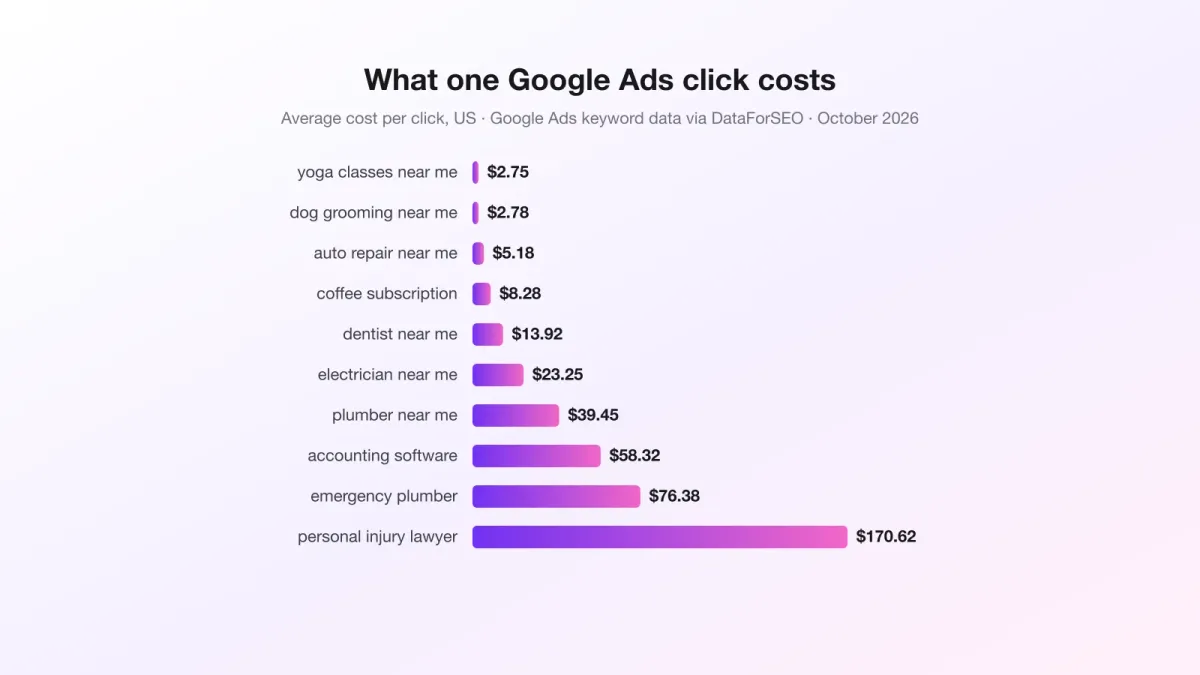
Google Ads has no fixed price. You pay per click, you set your own daily budget, and what a click costs depends on your keywords. In our data, the average US click ranges from $2.75 for “yoga classes near me” to $170.62 for “personal injury lawyer”. So the real answer to “how much does Google Ads cost?” is a formula: your budget divided by your cost per click is how many clicks you get, and that tells you what a budget can buy.
Key takeaways
- Google charges no setup fee and no subscription. You pay for clicks, and your budget caps the spend.
- Click prices vary 60× between small-business keywords. Your industry decides more than anything else.
- $10 a day buys around 110 clicks a month for a yoga studio, and fewer than 8 for a plumber.
- Start small, read the results weekly, and raise the budget in steps — not as far as Google recommends.
- The cost nobody quotes is managing the campaign: your time, or an agency fee that can be bigger than your ad budget.
How Google Ads pricing works
Search ads are sold in an auction. Every time someone searches, Google decides which ads to show and in what order, based on each advertiser’s bid and the quality of their ad and landing page. You don’t pay for being shown. You pay when someone clicks.
Three things keep it under your control:
- No setup fee, no subscription. Google says it plainly: there are no flat fees or monthly subscriptions.
- You often pay less than your bid. You’re charged what’s needed to beat the advertiser just below you, which is often less — sometimes much less — than the most you said you’d pay.
- Your budget is a ceiling. You set an average daily budget. On a busy day Google can spend up to twice that, but in a month it won’t charge more than 30.4 times your daily budget. $10 a day means at most $304 a month.
If you’re setting up your first campaign, my Google Ads setup guide walks through the budget and bidding settings step by step.
What a click really costs: real data for 30 small-business keywords
Averages for “all of Google Ads” are almost useless — nobody buys “all of Google Ads”. So we pulled the average cost per click for 30 keywords that small businesses actually buy.
Average cost per click in the US, from Google Ads keyword data via DataForSEO, checked on October 7, 2026. Monthly searches are US averages.
| Keyword | Avg. cost per click | Monthly searches |
|---|---|---|
| yoga classes near me | $2.75 | 165,000 |
| dog grooming near me | $2.78 | 450,000 |
| personal trainer near me | $4.74 | 165,000 |
| auto repair near me | $5.18 | 450,000 |
| teeth whitening | $5.26 | 165,000 |
| wedding photographer | $5.31 | 49,500 |
| buy coffee beans online | $5.36 | 260 |
| landscaping services | $6.43 | 40,500 |
| coffee subscription | $8.28 | 9,900 |
| real estate agent near me | $9.65 | 40,500 |
| flower delivery | $9.78 | 368,000 |
| accountant near me | $10.50 | 33,100 |
| house cleaning service | $11.67 | 90,500 |
| dentist near me | $13.92 | 1,830,000 |
| locksmith near me | $15.70 | 673,000 |
| web design agency | $19.03 | 12,100 |
| electrician near me | $23.25 | 368,000 |
| pest control | $29.50 | 201,000 |
| divorce lawyer | $29.97 | 246,000 |
| moving company | $32.01 | 201,000 |
| hvac repair | $34.77 | 74,000 |
| crm software | $38.64 | 165,000 |
| plumber near me | $39.45 | 823,000 |
| bookkeeping services | $39.63 | 18,100 |
| roof repair | $40.95 | 74,000 |
| seo services | $47.77 | 60,500 |
| project management software | $49.28 | 165,000 |
| accounting software | $58.32 | 90,500 |
| emergency plumber | $76.38 | 74,000 |
| personal injury lawyer | $170.62 | 201,000 |
The pattern is simple: the more a customer is worth to the advertiser, the more a click costs. One personal injury case can be worth a fortune, so lawyers bid accordingly. A yoga class is worth a little, so its clicks are cheap. Your own keywords will have their own prices — Google’s Keyword Planner shows estimates for them, and so does our free competitor keyword analysis for the searches your rivals win.
What pushes your cost per click up or down
You can’t change your industry, but you can change a lot around it:
- Competition. More advertisers bidding on the same keyword means higher prices. Long-tail keywords (“emergency plumber in Austin on weekends”) usually cost less than the head term and convert better.
- Ad and landing-page quality. Google’s auction rewards ads that match the search and pages that keep the ad’s promise. Better relevance tends to win better positions for less.
- Match types. Broad match reaches more searches, including some you’d never choose to pay for. Phrase and exact match keep the spend on the searches you meant.
- Negative keywords. Every click you block from the wrong search (“free”, “jobs”, “DIY”) is money that goes to a click that can convert.
- Location and schedule. Targeting only the places you serve, and the hours someone can answer the phone, stops paying for clicks that can’t become customers.
How much should a small business spend on Google Ads?
Start from what a customer is worth to you, not from a round number. The formula has two lines:
- Clicks per month = monthly budget ÷ cost per click.
- Customers per month = clicks × your conversion rate.
Here’s what $10 a day (about $304 a month) buys at the prices above. To keep the example simple, assume 1 in 10 clicks becomes a lead — your own rate will differ:
| Business | Avg. cost per click | Clicks per month | Leads at 1 in 10 |
|---|---|---|---|
| Yoga studio | $2.75 | ~110 | ~11 |
| Dentist | $13.92 | ~22 | ~2 |
| Plumber | $39.45 | ~8 | under 1 |
| Personal injury lawyer | $170.62 | under 2 | — |
So is $10 a day enough? For the yoga studio, it’s a real test. For the plumber, it’s barely a signal. A budget only means something if it buys enough clicks to produce a handful of conversions — otherwise you can’t tell whether the campaign works or you were just unlucky.
If your keywords are expensive, you have two honest options: a bigger budget, or narrower, cheaper keywords and locations where the same money buys more clicks.
How I’d set a first budget
I’d start small. Not so small it can’t learn anything — use the formula above to make sure the budget buys enough clicks — but small enough that a bad first week doesn’t hurt.
Then I’d watch two numbers: the cost per click I actually pay, and the conversions it brings. If the cost per conversion looks good, I’d raise the budget a bit, read the reports again after a week, optimize, and only then raise it again. Steps, not jumps.
What I wouldn’t do is raise it as much as Google recommends. Google’s own help page says applying its recommended budget will help you “increase clicks and impressions”. Clicks and impressions — not conversions, not profit. More of the wrong clicks just costs more.
The mistakes that waste a small budget
- Too many campaigns, too little money each. Five campaigns at $5 a day each means none of them gets enough data to learn, and none of them gets optimized. Better: one campaign per topic, split into several ad groups for the sub-topics and intents inside it. Each ad group gets its own keywords, ads and page, and the budget flows to what works.
- No conversion tracking. Without at least one conversion event — a form, a call, a purchase — and without Google Analytics connected, Google’s bidding has nothing to aim at. It spends anyway, and your costs go up. Set it up before you launch.
- Accepting every recommendation. Google wants you to succeed, and it also earns more when you spend more. Judge every recommendation by your cost per conversion, not by your optimization score.
- Never looking back. A campaign left alone drifts: new irrelevant searches, tired ads, budget stuck in the weak ad groups. A weekly look at the search terms report is where most savings come from.
The cost nobody quotes: managing the campaign
The click prices are only half the bill. Somebody has to build the campaign, write the ads, read the reports every week and act on them. That’s either your time or someone else’s money.
Most agencies I’ve seen charge a fixed minimum monthly fee plus a percentage of your ad spend — especially for small businesses, where the ad spend itself isn’t meaningful. For a big advertiser that works. For a small business it often means the management fee is bigger than the ad budget itself — you pay more to run the ads than for the ads.
That’s the trap a lot of small businesses sit in. They want the results a professional gets, but an agency costs more than their whole budget. Doing it yourself is cheaper, but it takes hours you don’t have, and the learning curve is real. There’s been no middle ground.
Are Google Ads worth the cost?
They are when a customer is worth more than it costs you to win one. Work out your cost per conversion — your cost per click divided by your conversion rate — and compare it with what a customer brings you over time. If the first is clearly lower, Google Ads is one of the most direct ways to buy growth: you pay only when someone who searched for what you sell clicks through.
If it isn’t lower yet, don’t give up on the channel; fix what’s between the click and the sale. Usually that’s keywords that are too broad, ads that don’t match the search, or a landing page that doesn’t keep the ad’s promise.
The middle ground: Convertus
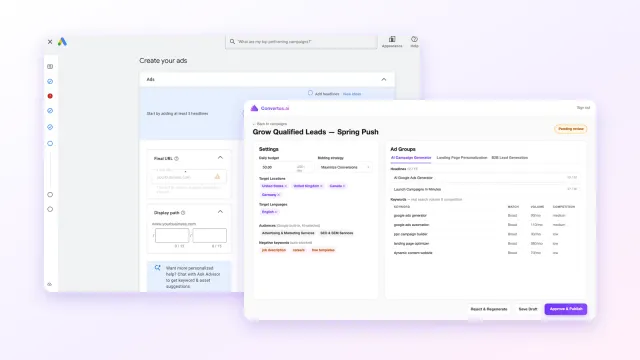
That gap is what Convertus fills: an effective campaign, very little of your time, and less money than an agency.
You describe your goal in one prompt, and the AI builds the whole Search campaign — several ad groups by intent, keywords chosen on real search volume and competition, ad copy matched to your page, and negative keywords from the start. Nothing goes live until you approve it.
Then AI agents review the campaign every week and apply the safe improvements — new keywords, negatives, match-type changes, refreshed ad copy. Budget and bidding changes always wait for your approval, because the goal is your cost per conversion, not your spend.
You can start a 14-day free trial — no credit card — and see what your first campaign would look like before you spend a cent on clicks.
Frequently asked questions
Is $20 a day good for Google Ads?
$20 a day is about $608 a month. Divide that by the cost per click of your keywords to see how many clicks it buys: around 220 clicks at $2.75, but only about 15 at $39.45. It is a good start where clicks are cheap, and very thin where they are expensive.
Is $1 a day good for Google Ads?
Not really. $1 a day is about $30 a month, which buys a handful of clicks even in the cheapest categories. That is too few to learn whether your ads work, so the money tells you almost nothing.
Are Google Ads worth the cost?
They are worth it when a customer is worth more than it costs you to win one. Work out your cost per conversion (cost per click divided by conversion rate) and compare it with what a customer brings you. If the first is clearly lower, scale up carefully; if not, fix the ads, the keywords or the landing page first.
What are the charges for Google Ads?
Google Ads has no setup fee and no monthly subscription. For Search ads you pay when someone clicks your ad, often less than your maximum bid, and you control spending with an average daily budget. Your account is charged for those clicks, plus any applicable taxes.