AI in marketing
What is AI visibility? How to measure it, and how to get cited by AI
By Alparslan Kapani · · 9 min read
AI visibility is how often AI answers, such as Google’s AI Overviews and ChatGPT, mention or cite your website when people ask questions about what you sell. You measure it by collecting the questions people ask in your field, recording which sites each answer cites, and comparing your share of those citations with your competitors’. You improve it the way you earn any citation: a page that answers the exact question better, and differently, from everything else on the subject.
Key takeaways
- AI visibility is a measurement: your share of the citations in AI answers about your field, compared with your competitors’.
- Google says AI Overviews reach more than 2 billion people a month, and people click far fewer links when an AI summary appears. Being the source the answer names now matters as much as ranking.
- In real reports, a few sites take almost all of the citations. In one market, two companies held 89% of Google’s AI citations among the sites we compared.
- AI answers cite pages that answer a specific question directly and completely. More content doesn’t win; better and different content does.
- There is no special markup or file that gets you in. Google’s own guidance is SEO fundamentals and helpful, people-first content.
What is AI visibility?
AI visibility is the share of AI-generated answers in your field that mention or link to your website. It is the AI-era version of “where do we rank?”: instead of a position on a results page, it asks whether the answer itself uses you as a source.
Two words matter here:
- A mention is when an AI answer names your brand or product.
- A citation is when the answer links to one of your pages as a source for what it says.
Citations are the stronger signal. A citation means the AI read your page, trusted it and quoted it. That’s why most AI visibility measurement counts citations.
A raw count means little on its own. “We were cited 40 times” could be excellent or terrible depending on the market. The useful number is your share of citations among you and your competitors, for the questions your buyers actually ask.
Why does AI visibility matter now?
Because a growing share of questions is answered on the results page, before anyone visits a website. In July 2025, Google’s CEO said AI Overviews have over 2 billion monthly users across more than 200 countries and territories.
When that answer appears, people click less. In a Pew Research Center study of 900 U.S. adults’ browsing in March 2025, Google users who saw an AI summary clicked a traditional search result in 8% of visits, against 15% when no summary appeared. They clicked a link inside the summary itself in just 1% of visits.
So the AI answer is often the last thing a buyer reads about a topic. If it names a competitor as the expert, that competitor gets the reader’s trust before anyone visits a website. Ranking still matters, because AI answers draw on pages search engines already trust. But for an informational question, being the source the answer names is now the visibility that counts.
How do you measure AI visibility?
You measure it question by question, in your market, against named competitors. A complete measurement answers five things:
- Which questions do people ask AI about your field? Not keywords, but real questions, the way people type them into Google’s AI or ChatGPT.
- Which sites does each answer cite? Every source link, per question.
- What is your share of citations? Your citations divided by all citations among you and your competitors, per AI platform.
- Where is a competitor cited instead of you? The questions where a rival is the source and you are not. This is your to-do list.
- Which page does the AI quote? Knowing the exact page it used tells you which of your pages has to beat it.
Two rules keep the measurement honest. First, measure per market and language: answers in Italian for an Italian buyer differ from answers in English. Second, compare like with like over time: the same market, the same competitors, a few weeks apart. One snapshot shows where you stand; the comparison shows whether your work is paying off.
You can check a handful of questions by hand: ask them, open the sources, note who is cited. That works for five questions. It stops working at the scale where the real picture appears, which is hundreds of questions, every answer’s sources, and several competitors. That’s where a tool helps. Convertus.ai, an AI tool for website personalization and Google Ads automation, measures it in its SEO, AI visibility and competitor intelligence report, which shows how often Google’s AI and ChatGPT cite you and each rival, the questions, the full answers and the pages they quote.
What does a real AI visibility report show?
Two real reports, anonymized, show the pattern: a few sites take nearly all of the citations, and the rest share crumbs.
An Italian tile retailer. Its own website was cited 2 times in Google’s AI answers for questions in its field. Its most-cited competitor was cited 600 times, and the next one 232. Across the seven sites in the report, the retailer held 2 of 926 citations. The report also listed 231 questions where Google’s AI cited the retailer’s top competitor and not the retailer. That list is more useful than the share: each question is a page to write or improve.
The same retailer had 33 searches where its pages already ranked on Google’s second page. Those pages are a good place to start on AI visibility too: they already rank, and AI answers draw on pages search engines can find and trust.
A B2B software company. Here is its competitors’ share of citations, with the company’s own row left out:
| Competitor | Google AI citations | Share | ChatGPT citations | Share |
|---|---|---|---|---|
| Rival A | 1,619 | 46% | 40 | 39% |
| Rival B | 1,532 | 43% | 58 | 56% |
| Rival C | 347 | 10% | 3 | 3% |
| Rival D | 42 | 1% | 0 | 0% |
| Rival E | 9 | 0% | 2 | 2% |
Two companies hold 89% of Google’s AI citations and 95% of ChatGPT’s among these sites. Rival D is a specialist in exactly the company’s niche, yet it gets 1%. Being the most relevant business is not enough; the AI cites the pages that answer the question.
The same report listed the other sites AI cited in those answers: YouTube (1,918 times), Reddit (618) and a handful of large platforms. AI answers draw on videos and community discussions as well as company websites.
Why does AI cite your competitor instead of you?
Because, for that question, their page is the better source. Cited pages tend to share some of these traits:
- It answers the exact question. Someone asking for examples of dynamic landing pages wants a page of examples, not a product page that mentions the term once.
- The answer is easy to lift. A clear definition, a numbered list or a table near the top. AI answers quote passages, so a passage that stands on its own gets used.
- It covers the whole topic. The follow-up questions a reader would ask next are answered on the same page.
- It says something the others don’t. Its own data, a real example, a clear opinion. If ten pages say the same thing, the AI has no reason to prefer yours.
- Search engines already trust it. It’s indexed, it ranks, other sites link to it.
- The AI can read it. The content is real text, not locked inside images or scripts, and crawlers aren’t blocked.
None of these is a trick. They’re what makes a page useful to a person, which is exactly what the AI is trying to find.
How do you get cited by Google’s AI and ChatGPT?
Start from the questions, not from your content calendar:
- Collect the questions in your market. Use an AI visibility report, the “People also ask” boxes, and the questions your sales team hears. Group them by topic.
- Find where a competitor is cited instead of you. Those questions are your list. Open the page the AI quotes for each, and read it.
- Decide what you can say that the cited page doesn’t. Your own numbers, a real customer example, a step it skips, a clear point of view. This step decides everything. AI models reward relevance and originality; they ignore the tenth copy of the same advice.
- Answer the question in the first two or three sentences, then go deeper. Put the definition, the steps or the comparison table near the top.
- Make every section stand on its own. A heading phrased as a question, opened by its direct answer, that still makes sense if quoted alone.
- Name things clearly. Your company, your product and the subject by their full names, the first time. An AI answer has to know what your page is about and who is saying it.
- Let the right crawlers in. Google says a page must be indexed and eligible to be shown with a snippet to appear as a source in AI Overviews or AI Mode. OpenAI says sites that block its OAI-SearchBot crawler won’t be shown in ChatGPT search answers. Check your robots.txt and your CDN’s bot settings.
- Keep the page current, and measure again in a few weeks, in the same market, against the same competitors.
What you don’t need: special AI files, hidden markup or a separate version of your site for AI. Google is explicit that there are no additional requirements to appear in AI Overviews or AI Mode, and no special schema.org markup to add. Structured data is still good practice, and it should match the visible text on the page.
My own view: quality and difference win, volume doesn’t. The sites that dominate AI answers rarely publish the most pages. They publish the page that is clearly the best answer to one question, and then the next one.
AI visibility vs SEO: what changes and what doesn’t?
Most of SEO still applies. AI answers draw on pages search engines can crawl, index and trust, so technical health, good pages and links still count. What changes is the unit you win and how you measure it.
| Classic SEO | AI visibility | |
|---|---|---|
| What you win | A position on a results page | A citation inside an answer |
| The unit | A keyword | A question |
| What wins it | The best page for a search | The best passage for a question |
| How you measure | Rankings, clicks, impressions | Share of citations vs competitors |
| Where you see it | Search Console | An AI visibility report |
The practical difference is focus. SEO often rewards covering many keywords; AI answers reward being the clearest, most useful source for each question. A page that wins both does both: it ranks for the search and gets quoted for the question behind it.
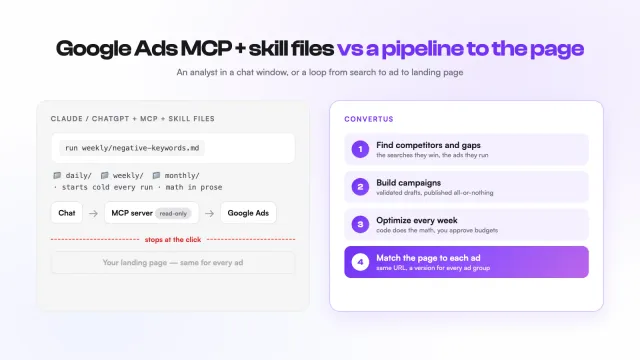
If you run paid search too, the same research does double duty: the questions where AI cites a competitor are often searches you can also cover with ads while your page earns its place. I wrote about where AI assistants help in Google Ads, and where they don’t, in Google Ads MCP with Claude or ChatGPT. For what to put on the page once a visitor arrives, see these website personalization examples by visitor type.
Frequently asked questions
Is AI visibility the same as GEO or AEO?
They are two sides of one job. GEO (generative engine optimization) and AEO (answer engine optimization) are the work you do so AI answers use your pages. AI visibility is the measurement: how often those answers actually cite you, for which questions, and against which competitors.
Does schema markup get my site into AI Overviews?
Not on its own. Google states that no special schema.org markup is needed to appear in AI Overviews or AI Mode. Structured data is still worth having, and it should match the visible text on the page, but the deciding factor is a page that answers the question well.
Do AI answers send traffic to the sites they cite?
Some, but less than a classic search result. In Pew Research Center's 2025 study, people clicked a link inside Google's AI summary in about 1% of visits. The bigger value of a citation is that the answer names you as the source to a reader who is still deciding.
How long does it take for changes to show up in AI answers?
There is no fixed timeline. A page has to be recrawled before an AI answer can use the new version, and answers change as competitors publish too. Measure once, improve the pages behind the questions you care about, and compare the next measurement in the same market a few weeks later.
How often should I measure AI visibility?
Monthly is enough for most businesses. AI answers shift as new pages appear, so one snapshot tells you little. A monthly measurement in the same market shows whether your share of citations is rising, which questions you won and which a competitor took.